Upstart Theory

Let's say you're running some kind of deck that wants to see some specific four-of in its opening hand, just for ease here. Now, I'm not going to pretend to be some math wiz who's able to explain why the math works. FarfaYGO has a nice video that explains how to use a hypergeometric calculator while also detailing why you should max important cards (this is a concept that, if I were to talk about it myself, I'd probably put in a beginner's guide to deckbuilding. This is an article for intermediate players or relatively new players). Anyway, let's plug and chug.
We'll start with our 50-card, Upstartless deck and a standard 6-card opening hand with the end goal of getting at least a single copy of a 4-of in your opening hand (this would be x≥1 in your results using this calculator). Here's a Gyazo link to the numbers. As you can see, the odds of getting at least one copy of Your Boy is .4105, which translates to 41.05%. While that's not bad, let's see what reducing the population by even just a playset of our hypothetical Upstart. Hmm, only a 2.94% increase. Well, that's a little underwhelming.
Let me put it to you this way, though. You're reading on a budget blog. What does this mean? You're most likely playing an underwhelming deck. See Ozons. Instead of trying to push your power, why not try to push your consistency? Having a gameplan's important, and if you can do what works then you should stick to it. What else does budgetfighting mean? You need to squeeze every last ounce of potential out of what you have. 3% is minuscule, but it's still an increase. In fact, it's a relative increase of 5%, which is what a lot of people would consider at least worthy of attention. Credit to a friend of mine on my Vanguard discord, Gold, for pointing this out, as my mind just didn't register it.
We'll start with our 50-card, Upstartless deck and a standard 6-card opening hand with the end goal of getting at least a single copy of a 4-of in your opening hand (this would be x≥1 in your results using this calculator). Here's a Gyazo link to the numbers. As you can see, the odds of getting at least one copy of Your Boy is .4105, which translates to 41.05%. While that's not bad, let's see what reducing the population by even just a playset of our hypothetical Upstart. Hmm, only a 2.94% increase. Well, that's a little underwhelming.
Let me put it to you this way, though. You're reading on a budget blog. What does this mean? You're most likely playing an underwhelming deck. See Ozons. Instead of trying to push your power, why not try to push your consistency? Having a gameplan's important, and if you can do what works then you should stick to it. What else does budgetfighting mean? You need to squeeze every last ounce of potential out of what you have. 3% is minuscule, but it's still an increase. In fact, it's a relative increase of 5%, which is what a lot of people would consider at least worthy of attention. Credit to a friend of mine on my Vanguard discord, Gold, for pointing this out, as my mind just didn't register it.
The only time you shouldn't be maximizing consistency is when you're upping your answers. I could go into floor and ceiling, but that's a debate for another day. What I'll refer to as "Upstart slots" can be filled by either Upstarts or by techs and answers to problems your deck has. In the end, you can choose to follow Upstart theory or choose not to. Just know what it is. Being aware of deckbuilding concepts helps you both improve as a builder and better understand other people's lists.
Searchers
Searchers
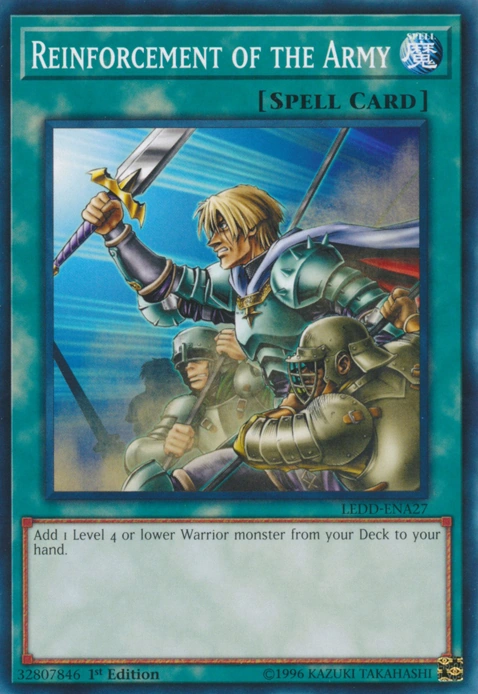
What this translates to in our handy-dandy hypergeometric calculator is more in the section of "number of successes in sample." Let's plug and chug.
We'll keep the same prompt of wanting a 4-of in our deck in our opening hand at at least one copy. Instead of Upstart, though, we'll take a Dragon Within the Ocean clone as our spice. Instead of decreasing the population size, we increase the number of successes in our population.
Well, would you look at that? We go from 41.05% to a whopping 66.99%. That is pretty undeniably fantastic. This means that you'll open Your Boy two thirds of the time, which is pretty good considering we only have 4 of a searcher and 4 of the target.
I don't think I even need to explain why you need to run searchers at as many copies as possible. You have an increase of 25.94%, which is a 63.19% relative increase. This is unarguably a significant increase. While Upstart Theory is somewhat player preference, searchers undeniably boost consistency. The only time you shouldn't be applying this concept is when your searcher gets in the way of your other cards (for example, a 2 gauge cost to search a card that takes 2 gauge to call, shutting off first turn options).
Consistency aside, there are some sick tricks you can do in some cases with searchers. For example, you can run more copies of your searcher than your target if your target isn't applicable to every scenario. For example, you could use Gemologist at 4 but have 1 to 2 copies of several Prism Dragons for various situations in your deck. At any given moment, Gemologist can act as extra copies of said Prism Dragons but not as the other. For example, if you run, uh, let's say 1 Blante and 1 Athora with 4 Gemologist and ignore gauge in your statistics, you can effectively say you have 5 Blantes and 1 Athora in your deck when you need lifegain, but say the opposite for other situations. It gets a little funky when gauge gets involved, but it's a neat little concept you can mess with while you're deck building.
I don't think I even need to explain why you need to run searchers at as many copies as possible. You have an increase of 25.94%, which is a 63.19% relative increase. This is unarguably a significant increase. While Upstart Theory is somewhat player preference, searchers undeniably boost consistency. The only time you shouldn't be applying this concept is when your searcher gets in the way of your other cards (for example, a 2 gauge cost to search a card that takes 2 gauge to call, shutting off first turn options).
Consistency aside, there are some sick tricks you can do in some cases with searchers. For example, you can run more copies of your searcher than your target if your target isn't applicable to every scenario. For example, you could use Gemologist at 4 but have 1 to 2 copies of several Prism Dragons for various situations in your deck. At any given moment, Gemologist can act as extra copies of said Prism Dragons but not as the other. For example, if you run, uh, let's say 1 Blante and 1 Athora with 4 Gemologist and ignore gauge in your statistics, you can effectively say you have 5 Blantes and 1 Athora in your deck when you need lifegain, but say the opposite for other situations. It gets a little funky when gauge gets involved, but it's a neat little concept you can mess with while you're deck building.
In Closing
I hope you all enjoyed this post. I'm hoping to do some more of these concept posts. Maybe something about power vs consistency, maybe a discussion on Stratos/Ozon-A clones, maybe something on deck types. I'm a huge fan of explaining concepts like these and this budget blog is an excellent place for me to reach out to beginning and novice players, so I have no doubt that I'll have some more stuff around here. Plus, as you can see, many of these concepts can be applied to multiple games, which is absolutely my cup of tea. Stay frosty.

No comments:
Post a Comment