Hey hey. So, considering I'm writing here, I feel like I should talk about what I think of when I hear "budget deck." I've got a pretty loose definition, so I'll go ahead and point you guys to the other Budgetfight's article, Vanguard's version (man, maybe I should rename this somehow so I'm not referring to two things as Budgetfight), before I start. While I'd up the budget constraints a tiny bit, the article's pretty great. I will also say the same thing about Buddyfight Theory's article. Anyway, I'm sure you're not here to read from a blog for another card game and a blog that hasn't updated in about three years now.
For a short explanation: Budgetfighting in Buddyfight is easier than most games. Well, maybe not easier, but certainly more effective than, say, Cardfight!! Vanguard. The line between budget and competitive is a little bit blurred. This article goes over, in my opinion, why that is and how you actually go about effective budget building.
Now, Chang and I have similar ideas on budgetfighting because we're not fools with no idea what we're doing, but I want to present myself and the blog a little bit differently. Chang's style of writing is a bit more rigid than mine.
Note that last sentence. I'll try not to let this article devolve into gushing, but Buddyfight allows for an absolutely fantastic budget scene that is, in my opinion, largely unrivaled. The closest things are Yu-Gi-Oh! and Magic: The Gathering, and even those have some problems from a "casual looking to play a little more often" standpoint.
Now that we've gotten that out of the way, let's discuss the how.
Anyway, budget building done right is, at its core, based on acknowledging that you have to make sacrifices and/or find replacements. Yes, find replacements. That's what makes budget Buddyfight so interesting to me. There are a lot of great alternatives to cards and the card pool is wide enough that there are a lot of options that can be thought of as alternatives but look like actual choices. Woah, that sounds weird. What I mean to say is that Buddyfight, from my perspective, has set itself up remarkably well as a game that advocates player preference without letting people play many bad cards. That probably makes me sound like an elitist tool, but I'm serious.
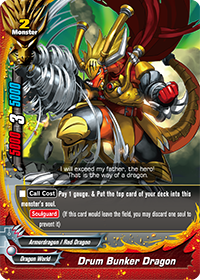 Unlike something like Vanguard or Yu-Gi-Oh!, which both have a lot of packfiller cards, Buddyfight has quality cards of every rarity, especially now that they're giving every world support in every set and reprinting old staples. What this means is that there's little to no space dedicated to useless cards in sets. For example, Drum Bunker Dragon, an ace unit from season 1, is a R. The completely overstatted main character's ace for season 1 was a single rare card. The fact that so many quality cards are found at every rarity means that budget decks are at least somewhat competitive while casual scenes are closer to competitive ones than they are in most games.
Really, though, budget Buddyfight is fascinating. It's fun. It's effective. It's vast. It reminds me of Yu-Gi-Oh! without all the tier 0 formats and getting completely blown out by hand traps, you know? I like budget building in Yu-Gi-Oh!, but I don't really like my community for it as much and the online community is rather hit or miss. I like that the game allows for so many budget options, but it's far too fast and far too easy to have your entire turn halted by a single card. Casual formats are fun, but budget play is terrible if you want to do much past playing with your friends.
Anyway, you're not here to listen to me compare the various settings of the games I've played. You're here to figure out what a budget deck is and how to maximize your success in making one. Let's ride.
 As a relative newbie to BDF, I kind of have to dig deep to give some examples of budget cuts to competitive decks, although I do find this difficult even for games that I've played for longer. Heck, even Chang admitted he doesn't find this method easy. Let's see, thinking of what I play... Ah, Sun Dragons have a lot of low and high-rarity options for cards that are worth running. Mera Blade Dragon is a strong opening turn with three critical if you're taking the first move. Flarefang Dragon "SD" is a really, really good card, but the deck can function without it. You could run something like Born! Bal Dragon, but I'll talk about vanillas later down the line.
Spells are a little more difficult in my opinion, since there isn't really a such thing as a vanilla spell, except for something like Dragonic Heal that's just 2 life, but the fact of the matter is that there are a lot of, uh, okay spells in Buddyfight that aren't fantastic or useful in the real build, but could be used as filler, one example being Dispersion in Prism Dragons. So yeah, long story short, this method is difficult for even veteran players, but is still perfectly valid.
Ok, when I said that budget building is about finding replacements, there's another facet. In the grand scheme of things, deck choice can sometimes be easier and more effective or cheaper than just cuts. In fact, the first deck I plan on writing is absolutely not a "cut-to-build" deck from Dungeon World.
It's an outright choice of deck that won't cost much. Part of this is the fact that it comes from an engine. Not to spoil anything, but the lineup of the deck is taken up by about eighteen cards of one archetype, meaning that the rest of the space is taken up by standard negate lineups, some synergistic cards to the archetype, and a little bit of the small gauge ramp that the archetype has access to. From there, there are only about... 24 slots to fill after the archetype and the standard negates, about 20 after a set of a gauge ramp card, 16 to 18 after a few copies of a nice vanilla, and 12-14 after a set of a weapon that you have to actually figure out. One of my favorite approaches to budget building is engine creation. If you find a cheap archetype that isn't necessarily absolutely terrible, you can easily use it to fill space, much like using Upstart Goblin in Yu-Gi-Oh!.
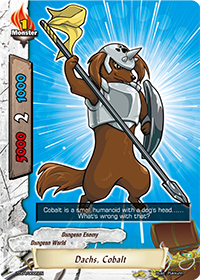 Speaking of filling space, vanillas are great (outside of Magic and maybe Katana worlds). Vanillas in Buddyfight are fantastic. Unlike other games' vanillas, you've got lots of options for the same sizes in different worlds, each one typically opting for different stat spreads. Most vanillas have pretty solid attacking stats, if nothing else. Obviously, you'll have to see for yourself what you value. Do you want high attack or defense? Do you want high crit? Generally, there's a vanilla that adapts to what you want. Generally, I find size 0 and 1 vanillas to be my favorite, so I end up having to pick favoring attacking power, just for the record. Size 2 and 3 vanillas tend to have pretty balanced stats, making them pretty flexible.
Long story short, I would suggest taking the time and/or money to gather sets of each vanilla you can for space filling and memes. I could go into statlines and tell you why you might want to discount Magic and Katana, but that's already been handled by Blaise.
The very last thing I'd like to mention, while not the most important, is one of my favorites. Trial decks are so good in this game. As Blaise mentions, trial decks in Buddyfight are better than Vanguard trial decks. Yes, dear reader, this statement holds up even three years later. While Vanguard trial decks have gotten a lot better over time, Buddyfight's trial decks have always been absolutely fantastic from the beginning. Even now, though, they've still been improving, with such concepts as 5 of the intended buddy and reprints of valuable cards like Blue Dragon Shield.
They all have functioning gameplans at the only cost being a lack of the respective anime character's buddy's main form (except for the Danger World TD). In some cases, though, such as X-TD03's version of Batzz, the trial deck buddy can be better in some situations than the form they shill in the anime. Oftentimes, the trial-exclusive cards are pretty solid, too, such as A Distinguished Replenisher! being a nice gauge card that comes out to a +1 in the end. It's just so nice. Long story short here, check to see if your deck's world has a trial deck. They often come with negates, staples, vanillas, and other nice little cards that might find their way into your full build. You never know. Start decks are also good for staples, but they tend to have more vanillas than Trial Decks, so do with that what you will. Both are fantastic jumping off points that I can't recommend enough.
There's just one catch to all of this: Availability. Buddyfight is tiny compared to the giants that are Magic, Vanguard, and Yu-Gi-Oh!. The best sites I've found for Buddyfight cards are Card Academy, Ideal808, TCGeneration, Buddymart, Killer Kards, and (sometimes) TCGPlayer. It's hard to find a gauge for costs sometimes. What I'll do for the future is try to cross-reference the sites each time I make an article to bring you all, the readers, an expected price as-of the writing of the article. Prices are always subject to change and could be higher or lower than what I list, but rest assured that the price ranges will be as accurate as I can make them.
That's about it for now. Tl;dr, Buddyfight's budget scene is a breath of fresh air. There are several ways to go about it and I'm happy to be a tour guide on this wild ride. Until next time, stay frosty.

No comments:
Post a Comment